


Blog
Five Interesting Facts about Hogmanay
This article looks at the Scottish tradition of Hogmanay – its origins, how it differs from most countries’ New Year celebrations, and the form it takes today.
There’s also a brief summary of Hamiltons’ Removals services when it comes to moving to Scotland.
This article is a four-minute read.
Anyone interested in moving to Scotland should know about Hogmanay – it’s very different from New Year celebrations in the rest of the UK and across the world. Here we explain why.
Removals to Scotland with Hamiltons Removals
Whether you want to move to Inverness, Glasgow, Edinburgh, Dundee, or the Highlands and Islands, Norfolk removal company Hamiltons Removals can help. Call us on 01379 855203 to learn more.
1. The Celebration Can Last for Three Days (or Even Longer)
In most countries (including England), New Year celebrations start on December 31 and finish on New Year’s Day, which is usually a public holiday.However, although Hogmanay is the Scottish word for the last day of the old year, the celebrations run right through to January 2, which is also a public holiday.
So the word Hogmanay is now used more loosely to describe the entire period consisting of the last few days of the old year and the first few days of the new year.
2. Its Roots Go Back Many Years
There are a number of theories as to why Hogmanay first came into being. It has strong pagan links that come from ancient festivals marking the winter solstice and the new year, involving bonfires and rituals to ward off evil spirits.
Others believe the roots of Hogmanay reach back to the celebration of the winter solstice of the Norse people, who regularly raided the country; the New Year was one of their regular feast days.
There is a connection with Mary Queen of Scots as well. When she returned to Scotland from France in 1561, she brought French customs and words with her – notably the giving of New Year gifts.
Whatever its precise origins, Hogmanay’s importance was initially heightened by the fact that Christmas Day celebrations were officially banned in Scotland for many years, thanks to a 1640 edict from the Reformed Presbyterian Church of Scotland. The Church viewed Christmas as an overly Catholic (and extravagant) public holiday. It wasn’t until 1958 that 25 December became a national public holiday in Scotland.
3. It Gave the World Auld Lang Syne
The Hogmanay custom of singing Auld Lang Syne has become common in many countries. The song is based on an 18th century Scots poem by Robert (Rabbie) Burns, which is in turn based on other traditional sources.
It is common to sing this in a circle of linked arms crossed over one another as the clock strikes midnight for New Year’s Day. However, it is only intended that participants link arms at the beginning of the final verse before rushing into the centre as a group.
4. There are Plenty of National Customs…
There are several countrywide customs associated with Hogmanay. These include first-footing, which says that the first person to cross a home’s threshold in the New Year will be a bringer of good fortune.
The ‘first-footer’ should give a gift – often of coal, or shortbread, or whisky, or a black bun (a form of fruit cake). This should bring good luck (in the form of warmth, food, or good cheer) to the householder.
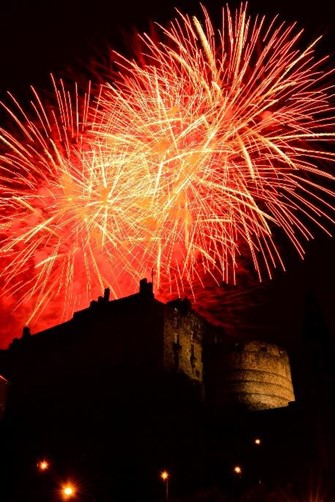
Many people clean their house before midnight on New Year’s Eve to rid it of all the bad luck of the old year in a process known as ‘redding’. Scotland also has its fair share of firework displays on December 31, notably by Edinburgh Castle (pictured).
5… and Local Ones Too
There are plenty of local traditions, some of which still survive to this day. For instance, The Stonehaven Fireballs Festival has its roots in pagan times. Residents of this Aberdeenshire town have paraded along the streets on Hogmanay, swinging giant fireballs to drive evil spirits away and purge the old year.
In Orkney, the Kirkwall Ba’ – a mass football match across the town – still takes place on New Year’s Day.
Removals to Scotland with Hamiltons Removals
At Hamiltons Removals, we can help with commercial and domestic moves to all parts of the UK. You can kick-start the whole process by opting for a video survey. You can receive an online quote by using another of our online tools here.
We offer plenty of choice in terms of services – you could opt for the simple transportation of your possessions, but we could pack and unpack everything for you (we would recommend this, particularly if you have anything valuable). Hamiltons also offer cleaning services for your new home, and insurance during the period of the move.
FAQS:
Q: Why would we recommend using our packing services?
A: Our team of specialist packers are highly experienced when it comes to taking care of valuable items – which includes art and antiques – as well as larger items such as machinery, equipment and vehicles if it’s a commercial move. We take great care to label everything and to avoid any breakages.
Q: Can Hamiltons supply its own packing materials?
A: Yes, we have a number of cartons and product-specific packaging materials available online and at our shop in Harleston. These are all high-quality (for instance, cartons are double-walled) to afford your possessions maximum protection.
You can check this out on YouTube here, along with our video for The Perfectly Orchestrated Move.
Q: How would we get your possessions to Scotland?
A: Hamiltons have a large selection of vehicles ranging from large articulated vehicles to medium-sized vehicles and small vans. We will always pick the most suitable vehicle for the journey (and your budget). For overseas moves, we usually ship items to their destination – either as part of a dedicated service or a groupage one (where your items are shared with other consignments).